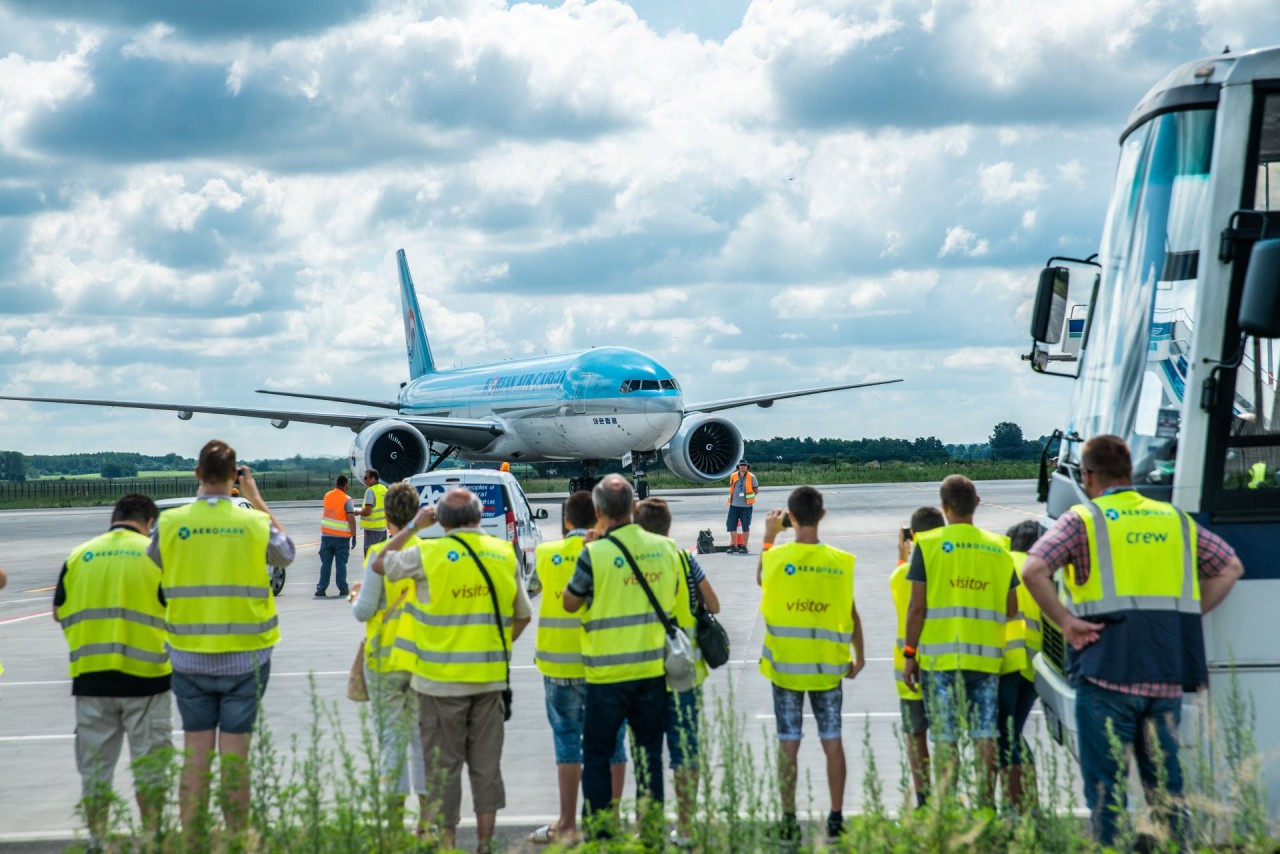
Retro vibes, big machines, up-close thrills. Budapest’s Ferenc Liszt International Airport is throwing open the doors to its off-limits world with daytime, evening, and night bus tours from Aeropark. Pick a date and dive into this self-contained mini-city where jets, lights, radars, and runway crews work to the second. It’s aviation beyond the terminal — come see what passengers never do.
A Hidden City Within the City
Ferenc Liszt International Airport runs like a standalone town: its own wells and waterworks, a treatment plant, even a heating power plant keep it humming. When a plane lands, think military precision — dozens of people hit their marks with second-by-second choreography so that in about 30 minutes, the aircraft can take off again. And air traffic control? The bulk of it doesn’t happen in the tower, or even on airport grounds. If you’ve never stood beside a runway’s landing lights, watched radars sweep, peered into the tower base, or seen the fire station up close, this is your ticket.
Runways That Glow and Take a Beating
Ferihegy runs on two offset, “bayonet” system runways designed to handle heavy metal touching down and rolling out. One runway is 3,009 meters (9,872 feet) long, the other 3,707 meters (12,162 feet). A runway is a long, flat concrete or asphalt strip where aircraft accelerate to lift off and, on return, brake to a safe taxi speed. Prevailing winds and local obstacles set the direction; length, width, load-bearing capacity, and instruments follow the aircraft types and the airport’s role. On the ground, planes park on aprons: traffic aprons turn aircraft in short bursts between flights for boarding, fueling, and loading; cargo aprons move goods; technical aprons near hangars host aircraft awaiting or exiting maintenance. Twisting networks of taxiways connect aprons to runways for efficient ground movement.
How Pilots Find Their Way
Runways, taxiways, and aprons sit on a unified bearing structure roughly 28 inches thick. Guidance comes from markings, lighting, and signage along the pavements. In low visibility, the 5,500 navigation lights at Budapest do the heavy lifting. Most are now LED for efficiency and lifespan, and many require regular calibration. Both runways support world-class Instrument Landing Systems (ILS) in both directions.
Why 13L/31R?
The runway designators reflect their magnetic direction, dropping the last digit and adding L or R for left/right when parallel. Approach the second runway from Monor and you get 31R; the same concrete from Rákoshegy reads 13L. The huge numbers are painted with glide-path-accurate distortion after the zebra-like threshold stripes. Apron and taxiway markings follow international standards and look as complex as a dress pattern at first glance, guiding aircraft within inches at jet-bridge gates. Even the octagonal red STOP sign appears on the concrete — with an aircraft symbol to remind ground drivers to yield to taxiing planes.
Keeping the Runways Perfect
Maintenance never stops. Winter brings snow removal; crews regularly strip rubber deposits from touchdown zones, refresh expansion-joint fillings, and service in-pavement or frangible-mounted lights. Many fixtures have their projection angles calibrated routinely by aircraft or special ground vehicles.
From Pastures to Parallel Power
Like many early airfields, Ferihegy began as an oval pasture, its outline still hinted at by service roads and old hedge lines. In the 1920s–30s, lightweight, low-power aircraft demanded headwind takeoffs and landings, with striped windsocks showing the way. Heavier, stronger planes pushed airports toward paved runways, usually aligned with the most “worn” grass — a proxy for prevailing winds. Budapest’s dominant wind is northwesterly, setting the first runway’s direction. The initial 1,500-meter runway opened in 1950, then stretched to 2,500 and later to 3,009 meters. A northeast–southwest cross-runway was once sketched, but as aircraft handled crosswinds better, it was never built.
The Second Runway Solution
In the 1970s, a second runway became a strategic must. With Ferihegy the country’s only public international airport, closing a single runway could halt Hungary’s air links. Engineers delivered a textbook setup: the second runway parallels the first, spaced 1,600 meters apart to allow independent operations, offset southeast into a Z, or bayonet, layout to shorten taxi times. Split roles double capacity: one runway handles arrivals while the other launches departures. A jet landing on 31R can roll almost straight onto Terminal 2’s apron; departing traffic can reach 31L with minimal taxi. The newer runway, commissioned in 1983, measures 3,707 meters long and 45 meters wide, expanding to 60 meters with two 7.5-meter paved shoulders. Its endpoints differ in elevation by 23 meters — well within the 1% slope tolerance. Cutting-edge lighting and ILS keep operations safe in low visibility.
Runway Run: Sneakers on the Strip
Every late summer for nine years, the airport has swapped landing gear for running shoes on Runway 1. About 1,100 industry participants race for charity, with entry fees supporting Hungary’s SUHANJ! Foundation and the UK’s Anthony Nolan Foundation for children’s bone marrow transplants.
What You’ll See on Tour
The route goes beyond public areas — and even beyond what most airport staff can access. Expect traffic and technical aprons, runways up close, navigation gear, radars, and a trove of previously off-limits spots, all by bus with guides who know the backstory.
How to Book: Individual, Group, VIP
– Individual tours: Register for pre-announced dates online, choose the tour type, see open seats, submit personal data, and pay. You’ll share the bus with other visitors.
– Group tours: For at least nine people, get a dedicated bus and slot. Book via the group form; provide participants’ data and payment per the confirmation email.
– VIP tours: For 1–6 people, book a 3-hour custom program (extendable for a fee) in vintage vehicles, subject to legal and airport limits. Buy a VIP coupon in the webshop, then arrange your time.
Security Checks and Deadlines
The airport is a strictly controlled site. All participants undergo official background screening, so personal data is required at registration. Tours close to new registrations five working days in advance — that’s the submission deadline. After that point, you can’t add participants or swap names.
Dates in 2026
– Jun 6: Public 2-hour family-friendly tour, Budapest
– Jun 6–7: Public 3-hour tour, Budapest
– Jun 13–14: Public 3-hour tour, Budapest
– Jun 27–28: Public 3-hour tour, Budapest
– Jul 2: Public 3-hour tour, Budapest
– Jul 4–5: Public 3-hour tour, Budapest
– Jul 9: Public 3-hour tour, Budapest
– Jul 11–12: Public 3-hour tour, Budapest
– Jul 16: Public 3-hour tour, Budapest
– Jul 18–19: Public 3-hour tour, Budapest
– Jul 23: Public 3-hour tour, Budapest
– Jul 25–26: Public 3-hour night tour, Budapest
– Jul 30: Public 3-hour tour, Budapest
Organizers reserve the right to change dates and programs.